Mutual funds can build a portfolio. The plan determines how they work together.
Mutual funds provide access to different asset classes, strategies and investment styles. The larger question is how those funds fit your goals, risk profile and time horizon — and how the portfolio stays organised over time.

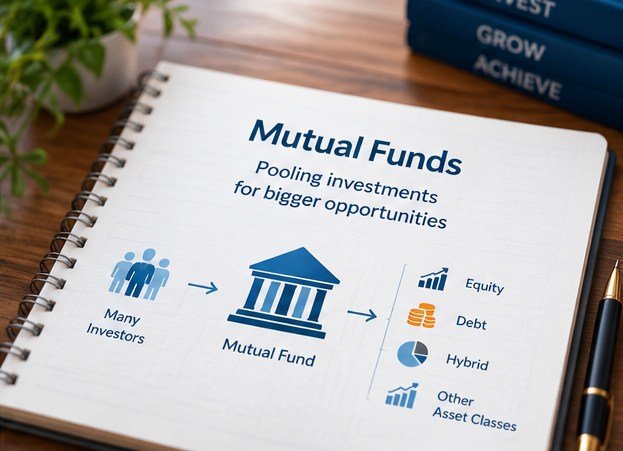
What are Mutual Funds?
A mutual fund pools money from multiple investors and invests it according to a defined investment objective. Depending on the scheme, the portfolio may invest in equities, debt securities, money-market instruments or a combination of asset classes.
Instead of selecting and managing every underlying security yourself, you invest in units of the mutual fund. Each scheme follows its own mandate, risk profile and investment strategy, which is why choosing a fund should start with understanding what role it is expected to play in your portfolio.
Types of Mutual Funds

Two common ways to invest in mutual funds.
You can invest periodically through a SIP or deploy money through a one-time lumpsum investment. Neither method is universally better — the appropriate approach depends on your cash flow, available capital, investment horizon and overall plan.
Systematic Investment Plan
A Systematic Investment Plan allows you to invest a fixed amount in a mutual fund at regular intervals, such as monthly. It provides a structured way to invest gradually instead of deploying the entire amount at once.
Regular investing • Investment discipline • Gradual deployment • Accessible starting point
Explore SIP Calculator →Lumpsum
A lumpsum investment means investing an available amount into a mutual fund in a single transaction rather than dividing it across scheduled instalments.
One-time deployment • Useful for available capital • Immediate market exposure • Plan still comes first
A flexible way to access diversified investments.
Diversification
A mutual fund can spread investments across multiple securities and, depending on the scheme, across different sectors or asset classes. This reduces dependence on the performance of any single security, although diversification does not eliminate investment risk.
Professional Management
Actively managed schemes are managed by professional investment teams within the scheme’s stated mandate, while passive funds follow defined indices or benchmarks.
Liquidity
Many open-ended mutual fund schemes allow investors to purchase or redeem units on business days at the applicable NAV. Liquidity and redemption conditions can differ depending on the type of scheme.
Accessibility & Convenience
Mutual funds provide a structured way to participate in portfolios of securities without having to individually research, purchase and administer every underlying investment.
Selecting funds is only part of building the portfolio.
Purpose & Timeline
Clarify what the money is intended for and when it may be required before selecting the investment structure.
Asset Mix
Decide how the portfolio should be distributed across asset classes before discussing individual schemes.
Fund Overlap
Organise existing holdings and identify unnecessary duplication between funds with similar exposures.
Review Discipline
Review the portfolio periodically instead of reacting to every short-term market movement.

A disciplined process, step by step.
Understand the objective
Start with what the money is for, the investment horizon and the investor’s broader financial situation.
Structure the asset mix
Determine how different asset classes may fit together based on the objective, horizon and risk considerations.
Select and organise the funds
Evaluate suitable mutual-fund categories and organise the portfolio while avoiding unnecessary duplication.
Review with discipline
Review periodically as circumstances, goals or portfolio characteristics change — without turning every market movement into a transaction.
Mutual funds are widely available. The value lies in how they are selected, combined, monitored and held as part of a coherent investment plan.
Mutual funds are market-linked investments.
Returns are not guaranteed
Mutual fund schemes are not assured-return products. The value of an investment may rise or fall depending on the securities and markets in which the scheme invests.
Different funds carry different risks
Equity, debt, hybrid and other schemes respond differently to factors such as market prices, interest rates, credit conditions and liquidity.
Time horizon matters
A scheme suitable for a long investment horizon may not be appropriate for money that could be required in the near term.
Risk should match the investor
Scheme selection should consider the investor’s objectives, investment horizon and ability to tolerate fluctuations rather than relying only on recent returns.
Mutual Fund investments are subject to market risks. Read all scheme-related documents carefully.
Build the portfolio around the goal.
Already investing in mutual funds or planning to start? Bring us your objective, time horizon and existing holdings. We can help you organise the portfolio with greater clarity and discipline.